
In this DreamHost vs HostGator comparison article, we’ll cover all the important issues you should consider when looking for a web hosting service. I will analyze the most important features of both providers, starting with pricing, then usability, performance, security and also customer support.
DreamHost is a critically acclaimed hosting provider for its hassle-free WordPress hosting. HostGator is suitable for both beginners and professionals with its simple control panel and management.
Like any other web host, both have their pros and cons – so which one is the best?
Table of Contents
DreamHost vs HostGator: Quick Comparison
Both DreamHost and HostGator are extremely popular hosting services – and not without reason. DreamHost advertises super-fast speeds, a user-friendly interface and a range of features that go beyond simple web hosting. HostGator is popular for its beginner-friendliness combined with a very good level of performance.
| DreamHost | HostGator | |
| Rating | 4.4⭐⭐⭐⭐ | 4.0⭐⭐⭐⭐ |
| Price from | From $2.59/month | From $3.75/month |
| Free domain | Yes | Yes |
| Hosting types | Shared, WordPress, VPS, Cloud, Dedicated | Shared, WordPress, VPS, Cloud Dedicated |
| Control panel | Custom control panel | Native user interface +cPanel |
| Security | SSL certificates, Web Application Firewall, daily backup, domain privacy protection | SSL certificates, server-level Firewall |
| Support | Live chat (5:30 AM – 9:30 PM PT), paid phone support, 24/7 ticketing system, knowledge base | 24/7 Live chat, 24/7 phone support, knowledge base |
| Website migration | Free website migration plugin, paid options for website migration | One free WordPress/cPanel migration and inter-server migration |
| Extras | Domain privacy | |
| Website | www.dreamhost.com | www.hostgator.com |
Winner: DreamHost
DreamHost vs HostGator: Pricing Comparison
Both hosting services offer similar entry-level prices. DreamHost’s entry-level shared hosting plan is $2.59/month. HostGator is a bit more expensive, starting at $3.75/month.
And if you’re not that interested in shared hosting, both services offer other types of hosting options:
| Hosting type | DreamHost | HostGator |
| Shared hosting | ✔️ | ✔️ |
| WordPress hosting | ✔️ | ✔️ |
| WooCommerce hosting | ✔️ | ❌ |
| Cloud hosting | ❌ | ✔️ |
| VPS hosting | ✔️ | ✔️ |
| Reseller hosting | ❌ | ✔️ |
| Dedicated hosting | ✔️ | ✔️ |
| Visit DreamHost | Visit HostGator |
In this comparison, however, we will focus on the shared hosting offers. What does each provider offer in its most basic version?
The providers differ only in a few points in their offers. As you can see, DreamHost is slightly cheaper than HostGator and offers daily backups with only 50 GB of storage. If you pay only 16 cents more for HostGator, you get unlimited storage and your own professional email address. You’ll have to decide for yourself which features are most important to you.
Remember that unlimited here doesn’t mean you can upload hundreds of GB worth of files to your website – no server is truly unlimited. When the server space is almost exhausted, additional drives are added to increase the storage space. To be accurate, unlimited disk space should be referred to as unlimited available disk space. Besides, although you can store as many files as you want, visitors can only access a certain amount of your website’s content at a time.
Now you are probably curious about which affordable hosting plans hide the best value within them.
DreamHost offers 2 different plans. Shared Starter for $2.59/month, and Shared Unlimited for $3.95/month.
Note that DreamHost’s low price is only available if you pay 3 years in advance. Also, note that the free domain is only valid for one year – after that, renewal costs $15.99. However, DreamHost offers an extended 97-day money-back guarantee – enough time for you to decide whether you want to stay with this provider or not. Keep in mind that the cancellation process involves closing your account – if you leave it open, you won’t receive any money.
Best Value
If you run a single website or blog, the Shared Starter plan is for you. It’s limited to 1 website and 50 GB of SSD space. However, if you’re a small business or looking to expand your offerings, the Shared Unlimited plan is a better option because you get unlimited websites and email accounts.
Moving on, HostGator offers 3 different plans. With the cheapest going for $3.75/month, and the most expensive selling for $6.25/month.
The cheapest HostGator prices come with a 3-year subscription. You’ll pay $182 total, but that means a lower monthly fee. And just like DreamHost, the domain name is only free for one year. After the renewal, you will have to pay $18.99 for the domain. In addition, HostGator offers a 30-day money-back guarantee for first-time users – not as much as DreamHost, but still quite a bit. If you end up going through the cancellation process, the cost of the domain will be deducted from your refund.
Best Value
The tariff with the most benefits is the Baby tariff. For just 1 extra dollar, you get unlimited websites. The Business plan offers a few interesting features, but the price difference doesn’t justify choosing this plan unless you absolutely need it for your business.
As you can see, both providers offer affordable prices and are included in our list of the best cheap web hosting deals – take a look, you might find an even better option for you there!
If you are looking for a cheap hosting solution for a personal or business website, DreamHost is the winner. For a lower price, you get everything you need, such as a free domain, an SSL and many security features.
Winner: DreamHost
Hosting Management: Ease Of Use
DreamHost and HostGator offer great ease of use. DreamHost offers its customers a fully custom control panel. HostGator uses the industry standard cPanel, which provides a great intuitive experience.
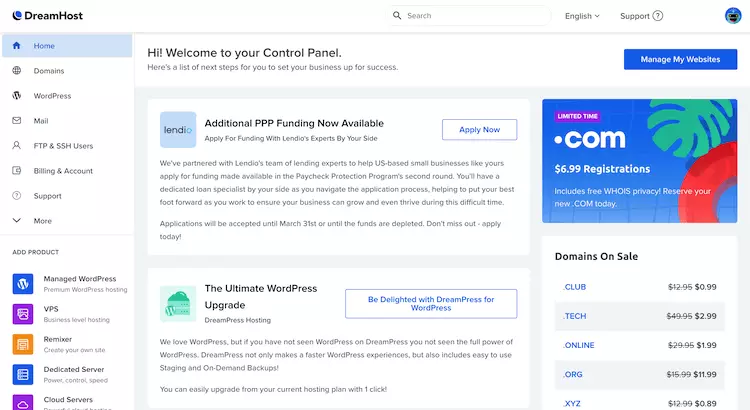
DreamHost is one of several providers that have their own custom control panel instead of using the standard cPanel. However, by using its in-house dashboard and management tools, DreamHost is able to offer perhaps the easiest WordPress installation on the market. While some providers advertise one-click WordPress installation, DreamHost seems to be the only provider that actually delivers on this promise. Moreover, this provider is not aggressive with its upsells.
To give you an idea, here’s how DreamHost’s control panel looks like – it looks modern and offers everything within reach of one click.
HostGator’s control panel is a bit more rudimentary.
HostGator helps you set up your website using a native dashboard and the cPanel. As always, the cPanel gives you access to advanced tools like domain, database, and file management. HostGator offers a simple cPanel with an icon layout that won’t cause any problems for novices and professionals alike. Once you get started, you’ll notice how easy it is to navigate.

Compared to the panel offered by DreamHost, this one seems to be more feature-oriented. There are two drawbacks: the lack of personalization and the constant upselling. It does allow for some customization, but by and large, the cPanel is what you see and what you get. While the WordPress installation usually goes smoothly, some users have reported errors occurring during the process. Also, it is definitely more complex than the advertised 1-click installation. Also, HostGator always tries to sell you something you don’t even need – so don’t be surprised if your cPanel contains hidden pages with upsell offers.
In direct comparison, both providers do a good job. There are no overly complicated steps to access a particular tool. The main difference between the two providers is DreamHost’s customizable interface compared to HostGator’s simpler layout. The former relies on a sidebar view with all the features and tools accessible through simple scrolling, while the latter offers a layout with lots of icons. It’s no surprise that these two providers are represented in our list of the best web hosting providers.
All in all, it’s a matter of personal preference. If you want WordPress to be easy to install, you should give preference to DreamHost, but otherwise both services do a good job in the “ease of use” category by keeping things simple.
Winner: DreamHost
DreamHost vs HostGator Performance
Both providers have shown that they know how to deliver the best results. DreamHost is known for its reliability, and during our test, its uptime and website loading speed lived up to the praise. HostGator also did a good job of keeping uptime above warranty while delivering solid response times and lightning-fast website loading speeds.
Uptime & Response Time
We have tested DreamHost’s performance for almost 2 months. With >99.99% uptime and only 1 minute of downtime, DreamHost’s results are almost unbeatable. For a provider that promises 100% uptime, this result is incredible. And even if the uptime was lower than promised, you would receive compensation.
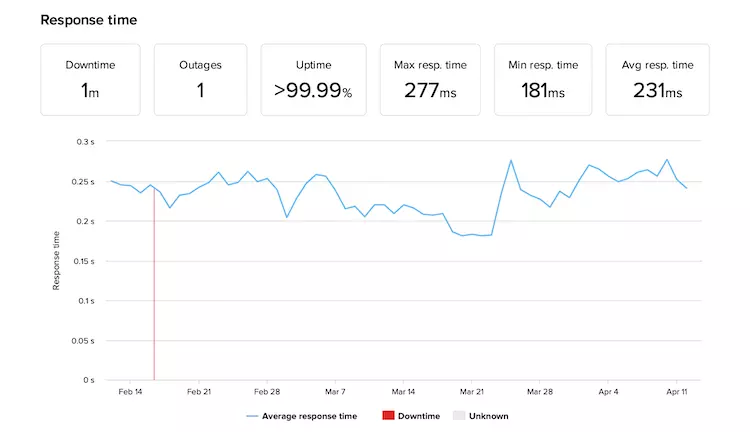
DreamHost’s server response time was also top-notch. This hosting provider delivered consistent results, with an average response time of 231 ms – far above the market average of 600 ms.
HostGator has been tested for almost 3 months now. And it did not disappoint. HostGator’s uptime guarantee is only 99.9%, but the total downtime during the test period was only 5 minutes, spread over 3 failures, resulting in an uptime of more than 99.99%. The uptime guarantee is quite low, but HostGator met it – and even if not, you would be compensated.

The average response time was also solid. It was not as incredible as DreamHost’s, but HostGator’s average of 525 ms is considered better than the market average of 600 ms.
In the uptime and response time subcategory, both vendors showed excellent results. However, DreamHost delivered better results and ended up being the faster and more reliable of the two providers.
Website Speed
The speed of a website is another important differentiator between good and excellent providers.
First of all, the Largest Contentful Paint (LCP) should load in less than 2.5 seconds – this is a standard set by Google. A full website should load in less than 3 seconds for a better user experience. And you don’t want to make your website visitors wait for your website to load, do you? A fast LCP helps a website rank well in search engine results, while full load time is crucial for a good user experience.
In the website speed test, DreamHost performed excellently with an LCP of 1.4s and a full load time of only 1.6s.
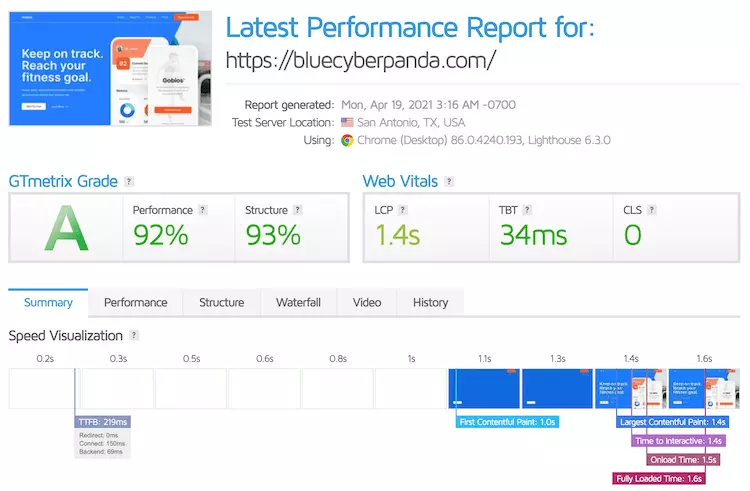
On the other hand, HostGator excels at website speed. The LCP was only 1.1s, even below DreamHost’s great mark in the same test. Meanwhile, the full load time is a lightning-fast 1.2s, less than the 1.6s registered by DreamHost.

In the website speed subcategory, HostGator takes the crown by a narrow margin. Here, both hosting services did a good job of exceeding the market average and providing a great experience for the user.
Keep in mind, however, that website loading speed is highly dependent on where your server is hosted and where your website visitors are coming from. In our case, our websites are hosted in the US and tested in the US. For the best results, servers need to be close to your audience, but both DreamHost and HostGator only have servers in North America – so these providers are not the best choice if your customers come from other continents.
Overall, both providers delivered good performance. Uptime was similar for both hosting services, but DreamHost is the clear winner when it comes to response time. In terms of website speed, DreamHost and HostGator delivered similar results, with the advantage going to HostGator.
Winner: HostGator
Website Security
In terms of security, DreamHost offers more security features than HostGator in its Starter plan. DreamHost’s Shared Starter package includes SSL certificates, firewalls, daily backups, and domain privacy. HostGator’s Hatchling plan includes SSL certificates and server-level firewalls.
In terms of security, DreamHost is missing only one feature, but you can purchase that separately. For just $29.99/year, the provider includes a malware protection tool in its offering. It comes to another $3/mo, and while it’s a shame it’s a paid feature, having a malware protection tool can turn out to be a game changer. Is it so surprising that DreamHost is on our list of the most secure web hosting providers, with all the features it has?
HostGator also offers paid tools to make up for the lack of security in its basic package:
It’s not close between the two in the security department. In the battle between DreamHost and HostGator, the first vendor is the clear winner as it offers more for less money. While both providers charge a similar price for a malware protection tool, DreamHost manages to offer daily backups for free, while HostGator charges $23.95.
Winner: DreamHost
Customer Support
As for customer support, both DreamHost and HostGator offer self-help resources as well as a variety of direct support channels – live chat, phone support, and ticketing.
If you’re not a fan of knowledge bases (just remember that the ones offered by these providers are great), there’s a big difference between the two providers.
DreamHost’s customer support has 3 direct support channels to choose from. A live chat that works between 5:30 AM – 9:30 PM PT, phone support and 24/7 ticketing. DreamHost support may seem underwhelming at first glance. The lack of a 24/7 live chat option could be a deal-breaker. However, the ticketing system works great. Most of the time, issues are resolved within an hour using this system. And to calm your racing heart, you should know that there is always the option to consult the site’s tutorials and community that can help you as well.
On the other hand, HostGator offers live chat and phone support, both of which work 24/7. HostGator’s live chat option is one of the best in the industry. HostGator’s support staff are qualified professionals who can solve your problems in less than 10 minutes, which is impressive. The employee we had the chance to talk to was friendly, knowledgeable and really solved our problems quickly.
In the area of customer support, HostGator wins. While the ticket system at DreamHost works better compared to some of its competitors, the fact that live chat is limited to one time zone is a shame. HostGator delivered great results with a faster turnaround time.
Winner: HostGator
Conclusion
When comparing DreamHost and HostGator, both web hosting providers showcased commendable performance in various aspects. They exhibited reasonable pricing, strong overall performance, and user-friendly interfaces. Nevertheless, DreamHost slightly outperformed HostGator in uptime and response time, making it a more reliable option.
Pricing-wise, DreamHost had a slight edge, charging $2.59/month, while HostGator offered their services at $2.75/month. Although the difference was minimal, DreamHost emerged as the more affordable choice. Moreover, DreamHost’s fully customized control panel allowed for greater flexibility compared to HostGator’s industry-standard cPanel.
Regarding security, DreamHost was the clear winner. They provided more inclusive security features at a lower cost, whereas HostGator required additional payments for similar protection.
When it came to customer support, HostGator took the lead by offering 24/7 live chat and phone support, providing a more robust assistance system than DreamHost, although both companies offered reliable support.
Ultimately, the decision between DreamHost and HostGator depends on individual needs. If you value strong uptime, response time, and extensive customization options, DreamHost would be the preferred choice. However, if you’re a beginner seeking ease of use, accessibility, and top-notch customer support, HostGator would be the more suitable option for your requirements.
FAQs
Which hosting provider, DreamHost, or HostGator, is better for beginners?
DreamHost is more beginner-friendly. They have a user-friendly interface, making it easy to navigate and set up your website. HostGator is also user-friendly, but I found DreamHost’s setup process to be smoother and more intuitive for beginners.
What are the key differences between DreamHost and HostGator in terms of performance?
Both DreamHost and HostGator offer reliable performance, but DreamHost has a slight edge in terms of loading speeds and uptime. During my time with DreamHost, I noticed faster website loading times compared to HostGator, which can be crucial for user experience and search engine rankings.
Which hosting provider offers better scalability options for growing websites?
DreamHost excels in providing scalable hosting solutions. They offer a range of plans and resources that can accommodate the needs of a growing website. HostGator also offers scalable options, but I found DreamHost’s plans to be more flexible and customizable.
Do either of these providers offer a website builder, and if so, which one is better?
DreamHost offers a website builder, but I personally prefer HostGator’s website builder. HostGator’s builder provides more templates and customization options, allowing me to create a more unique and visually appealing website.
Are there any extra features or benefits that differentiate these hosting providers?
DreamHost stands out with its generous 97-day money-back guarantee, providing an extended period for users to try out their services risk-free. Additionally, DreamHost is known for its commitment to green hosting, which may appeal to environmentally-conscious website owners.
To read more similar articles, click here.
Thanks for visiting our Website. If you appreciate our work, kindly show us some support in our comments section. 🙂

Norman Dwemer is a tech blogger who focuses on the future of technology. his blog delves into emerging technologies such as artificial intelligence, blockchain, and quantum computing, as well as their potential impact on our lives and society. Rachel’s writings provide a sneak peek into the future of tech, examining the possibilities and risks of these cutting-edge technologies. he also shares the most recent developments and research in these fields, delivering the latest news and insights to his readers. Norman’s visionary outlook on the world of tech has establihed his as an authoritative figure for anyone interested in the forefront of technology.