
KeyCDN Review: Unlocking the Secrets to Accelerated Website Performance (September 2026)

KeyCDN Review: This is where content delivery networks (CDNs) play a crucial role. Among the many CDN options available, KeyCDN stands out as a cost-effective and feature-rich solution. With its extensive network coverage, advanced caching capabilities, and competitive pricing, KeyCDN offers an enticing package for website owners and developers looking to enhance their content delivery performance.
In this comprehensive KeyCDN review, we’ll dive into its key features, pricing structure, ease of use, and performance to help you determine if it’s the right CDN solution for your needs.
Table of Contents
KeyCDN Overview

We spend hours testing every product or service we review, so you can be sure you’re buying the best. Learn more about our testing.
KeyCDN is an easy-to-use content delivery network (CDN) that offers a robust feature set at a very low price.
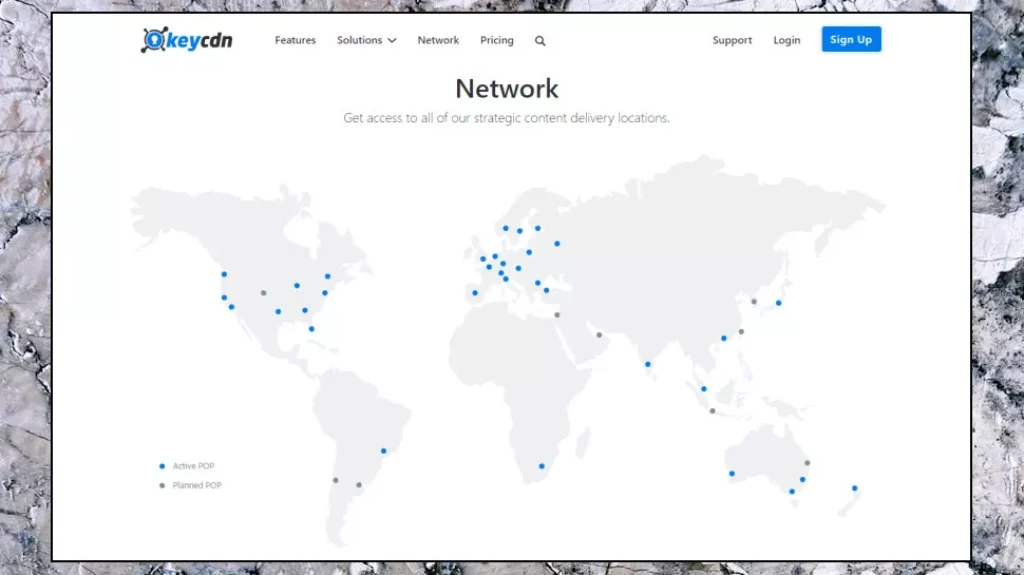
The company has an extensive network of 34 servers: 9 in North America, 14 in Europe, 5 in Asia, 4 in Oceania, and one each in South America and Africa.
The service supports both origin pull (KeyCDN takes content from your origin server when necessary) and origin push (you upload content to KeyCDN). The origin push features include the ability to upload content through your FTP account and synchronize it with sync.
KeyCDN can handle HTTP and HTTP/2 static content, HLS, and HTTP live streaming. GZip, HPACK, and Brotli compression is available to optimize performance.
Comprehensive image processing gives you more acceleration options. Whether you need to flip, crop, resize or crop an image, adjust the canvas size, sharpen, blur, or more, the KeyCDN API can do it with a single copy of the image stored on your edge servers. No need for the user to wait to download multiple images, KeyCDN simply transforms the image to suit your needs.

Security features include support for free shared SSL and custom Let’s Encrypt SSL certificates. There is some DDoS attack mitigation. KeyCDN can use HTTP referrers to block hotlinking, and you can keep out “bad bots” with a click.
The service offers a lot of settings and configurations to help customize operations, including the ability to create custom caching rules and a RESTful API to automate everything. The ability to view raw logs in your web console can help you identify any issues, or you can stream live logs via syslog to the destination of your choice (at an additional cost).

Pricing
KeyCDN pricing varies depending on the geographic origin of your traffic. It starts at $0.04 per GB for the first 10 TB in North America and Europe, rising to $0.08 in Asia and Oceania and $0.10 in South Africa and South America.
This is between half and a third of the prices paid with services such as CloudFront and Fastly. You also don’t pay for requests, only for traffic.
The price per gigabyte drops further as traffic increases, to $0.01 per GB after the first 100 TB.
Each account supports up to three “zones,” perhaps websites (depending on your configuration), and you can add more for a reasonable $1 per month per zone (the speedy 5centsCDN also charges $1 per zone).
Push zones can be useful for storing larger files, reducing the load on your origin server. They are charged at $0.29 per gigabyte per month up to 500 GB, dropping to $0.19 per gigabyte for the next 500 GB and $0.09 per gigabyte thereafter.
Image processing is a potentially costly extra: $1 per 2,000 operations. It’s not a big surprise, however, as it consumes a lot of processors, and the option could bring big benefits to some sites.
The free trial version gives you 14 days and 25 GB of traffic to try the service for yourself; no credit card is required. It’s a quick and easy way to get a look at the interface, configuration and support, but it’s not as generous as some of the competition. The CDN77 trial includes 1 TB of traffic, for example, enough to see how it works with even the largest sites.
Minimum charges seem low at $0.4 per month, but there’s a catch: a minimum credit of $49. If you’re happy with KeyCDN’s specs and think you’ll stick around, there’s not much to risk. But if you’re looking to keep payments low, StackPath CDN (formerly MaxCDN) starts at just $10 a month for 1 TB of traffic, while Cloudflare’s free plan gives you the (very minimal) CDN basics for nothing at all.

Setup
The KeyCDN registration process is one of the fastest and easiest we have seen. Enter your domain, email address, username, and password, and one more click takes you directly to the KeyCDN web panel. You get 25 GB of free traffic just for signing up, so there’s no need to enter your payment details unless you decide to subscribe.
The dashboard opens with an account overview where you can see your used storage, traffic, credit balance, and more.
If you have ever used another CDN, you will understand the basics right away. Click Zones > Add Zone, enter a zone name and the address of your origin server, and KeyCDN will get your zone up and running in 5-10 minutes.
The Edit Zone option gives you access to KeyCDN’s many zone options and settings. The list is long, but at least they are available in one place.
Some of these settings are familiar. You can set the maximum time an object will be cached before checking for an update (between 1-525949 minutes, 24 hours by default), enable GZip compression, enable HTTP/2 support, or enable/disable SSL settings.
SSL options include free shared SSL, free Let’s Encrypt, and custom SSL. You can also redirect HTTP requests to HTTPS with a couple of clicks.
A simple Force Download option can force files to download rather than open. You can often do the same in other CDNs by modifying the Content-Disposition header, but here it is much easier: a single click is all it takes.
An optional Origin Shield allows you to define a KeyCDN server as a shield. If other edge servers have not cached content, they will fetch it from the shield instead of the origin. This reduces traffic to your server, but will also partially reduce CDN performance, as the edge servers have to perform an additional step to read the new content.
Other features include header manipulation (add a canonical header to improve SEO), options to cache or delete cookies, or set up a custom robots.txt. Security options include the ability to block malicious bots, while the Secure Token feature can help you avoid hotlinks.
Once your zone is created, KeyCDN assigns it a URL similar to my domain-8c93.kxcdn.com. As usual, you can set up a custom CNAME record to make it more readable (cdn.mydomain.com). Change your site code to use this record for the objects you want to cache – “www.mydomain.com/image.jpg” becomes “cdn.mydomain.com/image.jpg” – and KeyCDN kicks in. On the first access, it reads the original file and shares it on the network. On subsequent accesses, the
A powerful set of reporting tools includes real-time statistics on traffic, requests per second, and cache hit rate. Graphs show traffic and storage usage over time and geographically. There is data on the most requested files, and a real-time logs dashboard keeps you up to date on the latest CDN events.
A link to Documentation refers beginners to simple articles with step-by-step tips to get started. Take a look at this “first steps” guide as an example. The article breaks the setup process into three tasks: creating a zone, figuring out which assets are suitable for use with the CDN, and integrating the CDN into your website. Each guide is relatively short, but the site at least covers a lot of ground; so, for example, the CMS section covers KeyCDN integration with WordPress, Joomla, Drupal, Magento, PrestaShop, Typo3, EpiServer, Ghost, Jango, OpenCart, SocialEngine and more.
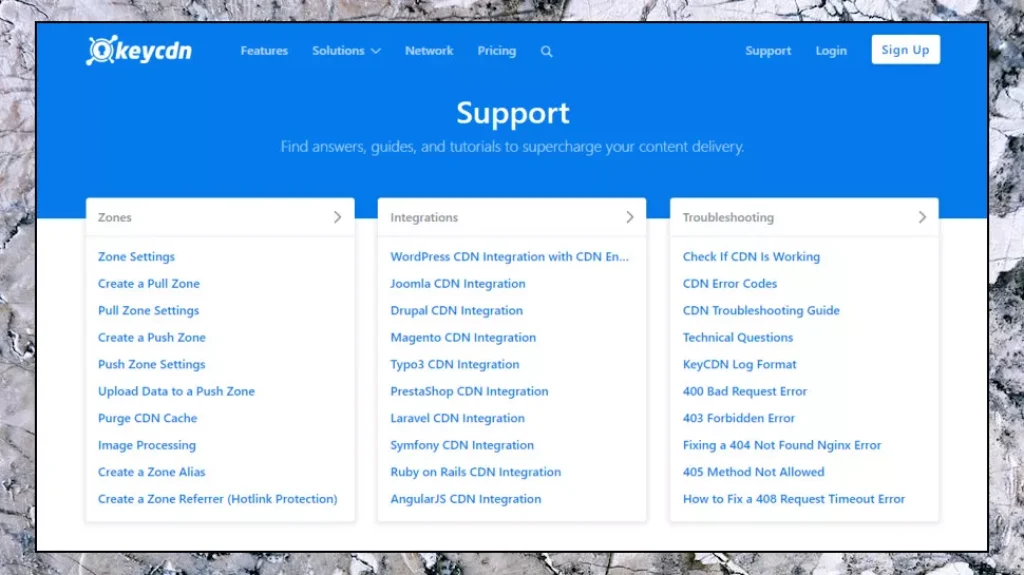
If the website cannot answer your questions, there is always the support team. KeyCDN does not have live chat, but email support is included at no additional cost, even for free trial users. We sent a couple of simple questions about the product and received a friendly and helpful response, but only after ten hours of waiting. That can seem like a long time if you run into serious technical problems.
Performance
What is the fastest CDN? It’s hard to say, as many factors come into play. The location and distribution of your visitors, the web applications you use, the size of the files you cache, and how often they are updated, as well as the additional optimizations the CDN offers.
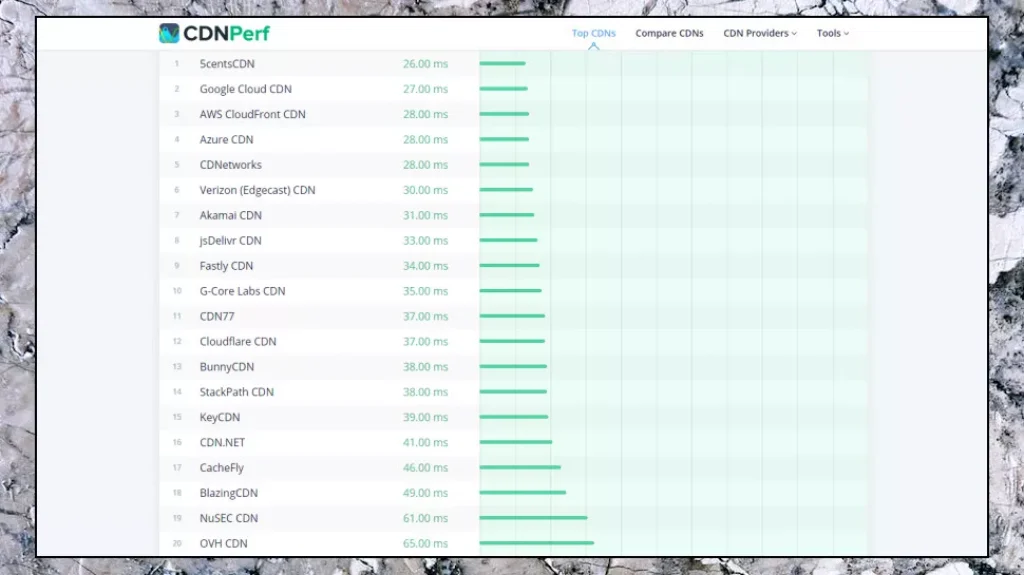
CDNPerf provides a simple starting point for measuring performance by comparing CDN response times experienced by real users around the world. It’s just one metric and doesn’t tell the whole story, but it will give you an idea of how providers compare.
At the time of writing, KeyCDN ranked 15th out of 20 for response times worldwide, with an average query time of 39ms. It outperformed some well-known names (CacheFly came in at 45ms, OVH CDN just 65ms) but couldn’t match Azure, CloudFront, and 5centsCDN.
Checking the continent-wide speeds reveals no major surprises. KeyCDN’s highlight is its seventh place in Oceania, but after that, it is thirteenth in Asia, fourteenth in Europe, Africa, and South America, and seventeenth in North America.
While this is a bit disappointing, keep in mind that there is very little difference between most providers. JsDelivr CDN ranked 8th, much better in response times globally but was only slightly faster at 33ms, and even the leader 5centsCDN averaged 28ms. KeyCDN is slower than average, yes, but it will be fast enough for many users and applications.
FAQs
Can KeyCDN help me optimize my website for SEO purposes?
Yes, KeyCDN offers features that can aid in SEO optimization. You can manipulate headers, such as adding a canonical header, to improve SEO signals.
Additionally, you have control over caching or deleting cookies and setting up a custom robots.txt file for search engine crawling.
Does KeyCDN provide any guidance or documentation for integrating with popular content management systems (CMS)?
Yes, KeyCDN offers documentation and guides for integrating with various CMS platforms. Whether you’re using WordPress, Joomla, Drupal, Magento, or other systems, KeyCDN provides step-by-step instructions for seamless integration and optimization.
Can I access detailed raw logs and real-time logs for monitoring and troubleshooting purposes?
Yes, KeyCDN allows you to access raw logs directly in the web console, providing detailed insights into the CDN events and any potential issues. Alternatively, you can stream live logs via syslog to the destination of your choice, albeit at an additional cost.
Is KeyCDN suitable for high-traffic websites or applications?
Yes, KeyCDN can handle high traffic volumes effectively. With its scalable infrastructure and competitive pricing, it is well-suited for websites and applications with significant traffic demands, providing efficient content delivery and performance optimization.
Can I rely on KeyCDN’s network availability and uptime for uninterrupted content delivery?
Yes, KeyCDN maintains a reliable network infrastructure and ensures high uptime for content delivery. With its distributed server locations and redundant systems, KeyCDN strives to provide uninterrupted service availability to maximize content delivery efficiency.

Mike DaVinci HighTechBlogging.com
Mike DaVinci is a skilled content writer with a talent for storytelling. He specializes in creating captivating narratives that engage readers and leave them feeling inspired. His writing has been featured in various publications, including magazines, blogs, and business websites. Mike’s particular interest in human interest stories allows him to uncover the heart of any story and convey it to his readers in an emotional and authentic way. He believes that storytelling is a powerful tool for connecting with people and inspiring positive change in the world.
To read more similar articles, click here
Thanks for visiting our Website. If you appreciate our work, kindly show us some support in our comments section. 🙂